Beginner
Words ranked 1–5,000
The core of English. These words make up about 85–90% of everyday speech and simple texts.
Free tool · CEFR word levels
Type a word to see if it is A1, A2, B1, B2, C1, or C2, and how common it is in English. Paste a paragraph to find the words that will slow a reader down.
Updated
Short answer
Type any English word into the checker below. It shows the word’s estimated CEFR level, from A1 (the 5,000 most common words) to C2 (rare words), and roughly how common it is. The levels are estimated from word frequency, the same method TeakReader uses for book and TV show levels.
Free tool
Type one word to see its CEFR level and how common it is. Or paste a paragraph (up to 3,000 words) to see which words are hard. Everything runs in your browser.
Learn them while you read
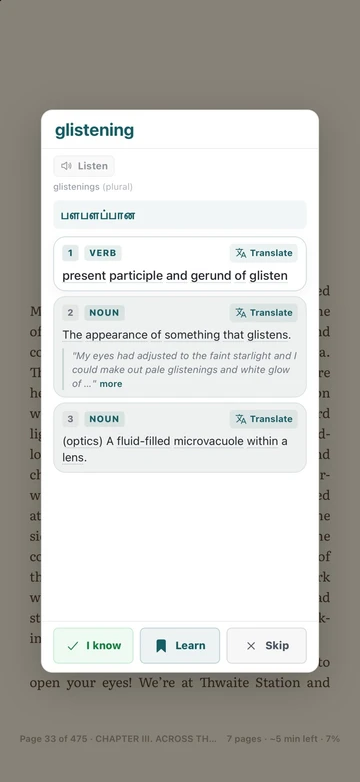
In TeakReader, tap any word in a book or subtitle to see its level, meaning, and translation, and save the hard ones as flashcards.


How it works: words are ranked by how often they appear in large English word-frequency lists. The 5,000 most common words are A1, 5,001–10,000 A2, 10,001–20,000 B1, 20,001–30,000 B2, 30,001–40,000 C1, and 40,001–60,000 C2. These are estimates from frequency, not the official Cambridge English Vocabulary Profile, so a few words will feel easier or harder than their band.
A1 to C2
The CEFR (Common European Framework of Reference) describes language ability in six levels. For vocabulary, a simple rule works well: the more common a word is, the earlier learners know it.
Words ranked 1–5,000
The core of English. These words make up about 85–90% of everyday speech and simple texts.
Words ranked 5,001–10,000
Common everyday words for familiar topics: travel, shopping, work, feelings.
Words ranked 10,001–20,000
Words you need to follow stories, news, and TV without stopping all the time.
apologyinterruptfragileworthwhileinspire
B1 word list with examples →Words ranked 20,001–30,000
Precise words for people, opinions, and situations. Common in novels and quality journalism.
meticuloushesitantuncannynavigatenewcomer
B2 word list with examples →Words ranked 30,001–40,000
Formal, literary, and nuanced words. They separate fluent from advanced.
exacerbateimpeccablesmugfiascogrudgingly
C1 word list with examples →Words ranked 40,001–60,000
Rare, technical, or old-fashioned words. Even native speakers meet many of them only in books.
Using word levels
For reading, what matters is the whole text: you need to know about 98% of the words to read comfortably. Read more in how many words you need to read a novel, or compare classic books and TV shows by level.
FAQ
Type the word into the checker at the top of this page and press Enter. You will see its estimated level (A1 to C2), roughly how common it is, and what that level means for learners.
Yes. Paste up to 3,000 words. The checker shows how much of the text a B1 or B2 reader will know, marks every B2–C2 word, and lists the hardest words first. To check a whole book, use the English reading level checker for books.
No. The English Vocabulary Profile is a research database of which words and meanings learners know at each level. Our checker estimates the level from how common a word is in large English frequency lists. For most words the two agree closely; for some words, especially ones with several meanings, they can differ by a level.
Frequency lists come from real texts, so some everyday words (especially food, household, and spoken words) appear less often in writing than you would expect. If a word feels easier than its level, it probably is easier in conversation.
Yes, for simple forms. If “cities” or “walked” is not in the list, the checker tries the base form (city, walk) and tells you when it did.
No. The word list is downloaded once and everything is checked in your browser.
Ready to read
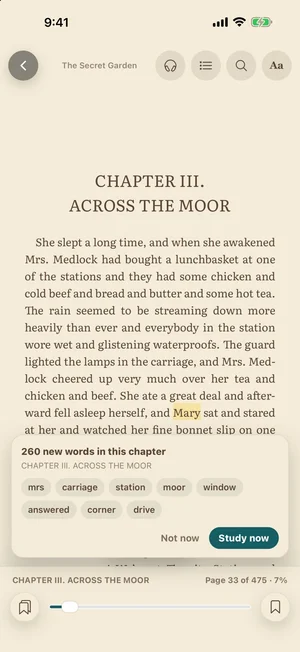
In TeakReader, tap any word in a book or subtitle for its level, meaning, and translation. Free on iPhone, iPad, and Android.