

Quick overview
What each level can read
| Level | What you can read | Known words* |
|---|---|---|
| A1 Beginner | Signs, short messages, simple forms, and picture books. Original novels are not yet possible. | under 1,500 |
| A2 Elementary | Short, simple texts about everyday topics. Graded readers. The easiest original children’s classics with help. | 1,500–2,500 |
| B1 Intermediate | Graded readers at B1, young adult novels, and the easier classics with dictionary support. You follow the plot but miss some detail. | 2,750–3,250 |
| B2 Upper intermediate | Most modern novels and many original classics. You understand the story well, but older style and rare words still slow you down. | 3,250–3,750 |
| C1 Advanced | Nearly all fiction, including Austen, Brontë, and Shelley. You notice irony, tone, and wordplay. | 3,750–4,500 |
| C2 Proficient | Anything, including dense literary fiction like Joyce. Remaining unknown words are rare or technical. | 4,500–5,000+ |
* Approximate, from Milton (2010), measured on the 5,000 most common English words. CEFR itself does not define word counts.
A1 reading level (beginner)
Signs, short messages, simple forms, and picture books. Original novels are not yet possible.
Tip: Use graded readers at Starter or Level 1, and learn the most common 1,000 words first.
A2 reading level (elementary)
Short, simple texts about everyday topics. Graded readers. The easiest original children’s classics with help.
Tip: Try one easy original with a tap-to-define reader. Expect to look up a word in most paragraphs.
Original classics that fit A2
- The Wizard of OzStrong A2 to B1 · 38,338 words
B1 reading level (intermediate)
Graded readers at B1, young adult novels, and the easier classics with dictionary support. You follow the plot but miss some detail.
Tip: Pick short books with a clear plot. Learn each book’s most frequent unknown words before you start.
Full guide: B1 reading level, with books and shows →
Original classics that fit B1
- Alice in WonderlandStrong B1 to B2 · 25,720 words
- Peter PanStrong B1 to B2 · 46,145 words
- The Adventures of Sherlock HolmesStrong B1 to B2 · 101,488 words
B2 reading level (upper intermediate)
Most modern novels and many original classics. You understand the story well, but older style and rare words still slow you down.
Tip: This is the level where reading originals becomes realistic. Use sentence translation for long, old-fashioned sentences.
Full guide: B2 reading level, with books and shows →
Original classics that fit B2
- The Time MachineB2 (strong B1 with support) · 30,696 words
- DraculaB2 · 154,425 words
- Little WomenB2 · 178,952 words
- Treasure IslandUpper B2 · 65,692 words
- The Secret GardenUpper B2 · 78,810 words
- Tom SawyerUpper B2 · 69,675 words
- Anne of Green GablesUpper B2 · 98,696 words
- A Christmas CarolUpper B2 · 27,822 words
- The Call of the WildUpper B2 · 31,509 words
C1 reading level (advanced)
Nearly all fiction, including Austen, Brontë, and Shelley. You notice irony, tone, and wordplay.
Tip: Read for pleasure. Save only words that repeat or that you want to use yourself.
Full guide: C1 reading level, with books and shows →
Original classics that fit C1
- The Great GatsbyUpper B2 to C1 · 46,035 words
- Dr Jekyll and Mr HydeUpper B2 to C1 · 24,500 words
- The Picture of Dorian GrayAdvanced B2 to C1 · 76,405 words
- Pride and PrejudiceAdvanced B2 to C1 · 123,685 words
- EmmaAdvanced B2 to C1 · 154,761 words
- FrankensteinAdvanced B2 to C1 · 68,715 words
- Jane EyreAdvanced B2 to C1 · 176,875 words
- Great ExpectationsAdvanced B2 to C1 · 176,206 words
- Around the World in 80 DaysAdvanced B2 to C1 · 62,169 words
- Wuthering HeightsAdvanced B2 to C1 · 111,062 words
- Moby-DickAdvanced C1 · 209,864 words
C2 reading level (proficient)
Anything, including dense literary fiction like Joyce. Remaining unknown words are rare or technical.
Tip: Focus on style and rare vocabulary in the authors you enjoy.
Best books for B1 English learners
At B1, choose short books with a clear plot and simple sentences. These are the originals we measured as most realistic for B1 readers, easiest first:
- The Wonderful Wizard of Oz by L. Frank Baum: The easiest original in our collection: short chapters, simple sentences, and a clear journey plot make it a realistic first classic for a confident A2 or B1 reader.
- Alice’s Adventures in Wonderland by Lewis Carroll: Short enough for an ambitious intermediate learner, but puns, nonsense, and Victorian expressions make B2 the more comfortable level.
- Peter Pan by J. M. Barrie: A short adventure with everyday vocabulary. The harder part is the narrator, who jokes with the reader and often says the opposite of what he means.
- The Adventures of Sherlock Holmes by Arthur Conan Doyle: The twelve-story structure and clear mysteries make this one of the most approachable originals here, although Victorian legal, household, and social vocabulary still requires support.
If these still feel hard, start with a graded reader at B1 and come back to the original later. For a longer list, seeeasy classic books for English learners and classics for intermediate learners.
Your level is not one number
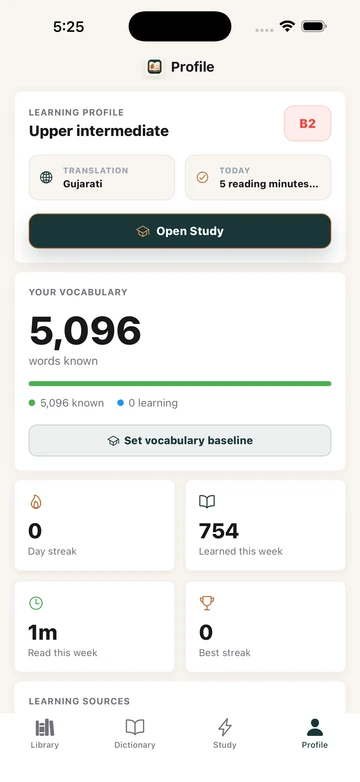
A B2 learner who loves detective stories may read Sherlock Holmes easily and still struggle with a science book. What matters is how many words of that book you know. About 98% means comfortable reading (see why).
That is why TeakReader measures the book and your own vocabulary together. Try thefree checker with any EPUB, or use the app to see your personal comprehension for each chapter.
Source: Milton, J. (2010), The development of vocabulary breadth across the CEFR levels. CEFR descriptors: Council of Europe.TeakReader levels are estimates, not official CEFR tests.