Easy originals, ranked by data

Easy classic books for English learners

Want to read a real classic, not a simplified version? These are the easiest complete originals we have measured, ranked from easiest. Each one links to a full analysis with the hard words to learn first.

Download on the App StoreGet it on Google Play

Updated

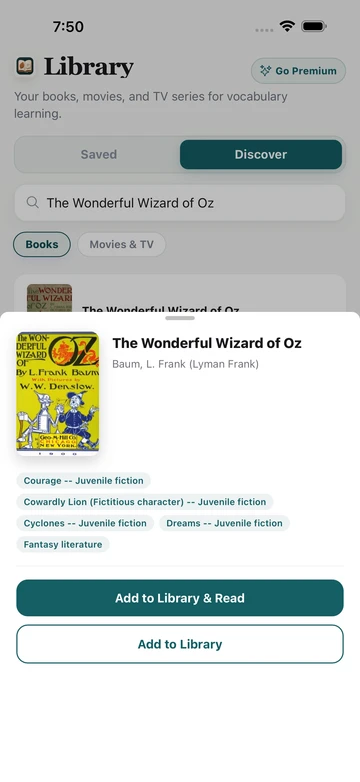
The Wonderful Wizard of Oz by L. Frank Baum in TeakReader Discover, ready to add to the library and read.

Short answer

Start with The Wizard of Oz.

The Wonderful Wizard of Oz is the easiest original classic on our list. A strong A2 learner can read it with a dictionary, and a B1 learner can read it comfortably. After that, move to Alice in Wonderland, Peter Pan, or a single Sherlock Holmes story.

Still finding these hard? That is normal. Try a graded reader of the same story first, then come back to the original. You will already know the plot, so the original will feel much easier.

Ranked from easiest

The 5 easiest original classics

We ranked these books by vocabulary coverage, sentence length, and how easy the story is to follow. The level is for the complete original text.

  1. The Wonderful Wizard of Oz

    L. Frank Baum, 1900 · 38,338 words

    Strong A2 to B1Easiest in this collection

    The easiest original in our collection: short chapters, simple sentences, and a clear journey plot make it a realistic first classic for a confident A2 or B1 reader.

    96.56% of running words fall within the A1–B1 bands.

    Full The Wizard of Oz analysis
  2. Alice’s Adventures in Wonderland

    Lewis Carroll, 1865 · 25,720 words

    Strong B1 to B2Moderate with wordplay

    Short enough for an ambitious intermediate learner, but puns, nonsense, and Victorian expressions make B2 the more comfortable level.

    96.32% of running words fall within the A1–B1 bands.

    Full Alice in Wonderland analysis
  3. Peter Pan

    J. M. Barrie, 1911 · 46,145 words

    Strong B1 to B2Short, playful, sometimes ironic

    A short adventure with everyday vocabulary. The harder part is the narrator, who jokes with the reader and often says the opposite of what he means.

    95.36% of running words fall within the A1–B1 bands.

    Full Peter Pan analysis
  4. The Adventures of Sherlock Holmes

    Arthur Conan Doyle, 1892 · 101,488 words

    Strong B1 to B2Approachable in short episodes

    The twelve-story structure and clear mysteries make this one of the most approachable originals here, although Victorian legal, household, and social vocabulary still requires support.

    96.63% of running words fall within the A1–B1 bands.

    Full The Adventures of Sherlock Holmes analysis
  5. The Time Machine

    H. G. Wells, 1895 · 30,696 words

    B2 (strong B1 with support)Short but descriptive

    A short novella with an exciting idea. The plot is easy to follow, but long descriptive passages and Victorian scientific language need B2-level reading stamina.

    95.79% of running words fall within the A1–B1 bands.

    Full The Time Machine analysis

Reading tips

How to finish your first classic

  1. Learn the 10 most repeated hard words first. Each book page lists them. Knowing them removes many interruptions.
  2. Read one chapter per day. Short, regular sessions work better than long weekend sessions.
  3. Do not look up every word. If you understand what is happening, keep reading.
  4. Translate whole sentences, not single words, when a sentence still makes no sense after two readings.
  5. Review your saved words the next day so they stay in your memory.

FAQ

Frequently asked questions

What is the easiest classic book to read in English?

Of the 24 original classics we analyzed, The Wonderful Wizard of Oz is the easiest. It has short chapters, simple sentences, and over 93% of its running words fall in the most common A1–A2 frequency bands.

Can an A2 learner read a classic novel?

A strong A2 learner can read The Wonderful Wizard of Oz with dictionary support. Most other originals are better at B1 or B2. If a book feels too hard, a graded reader of the same story is a good first step.

What is the difference between an original and a graded reader?

A graded reader is a shortened, rewritten version made for a specific level, such as A2 or B1. The original is the author’s complete text. The levels on this page are for the complete originals, not for graded editions.

How many words do I need to know to read a book comfortably?

Research on lexical coverage suggests you need to know around 95% to 98% of the running words in a text to read it comfortably. That is why we show how much of each book falls within the common A1–B1 frequency bands.

Are these books free?

Yes. All the editions we analyzed are free on Project Gutenberg, and TeakReader can find and open them in the app. Availability can vary by country because copyright rules differ.

Ready to read

Read your first classic with help on every page.

Find these books free in TeakReader, tap any word for its meaning, translate hard sentences, and review new words later.

Download on the App StoreGet it on Google Play