

Short answer
You need to know about 98% of the words
Research on reading shows that people read a text comfortably when they know about 98% of its running words. For most English novels, that takes a vocabulary of about 8,000–9,000 word families (Nation, 2006). With a dictionary, 95% is enough to follow the story (Hu & Nation, 2000; Laufer, 1989).
“Running words” means every word on the page, counted each time it appears. Common words like the and said count many times.
What does 98% coverage feel like?
A novel page has about 250–300 words. This is how many unknown words you meet per page at each coverage level.
| You know | Unknown words per page | How it feels | Vocabulary needed* |
|---|---|---|---|
| 98% | 5–6 | Comfortable. You can read for pleasure and guess most new words. | ≈ 8,000–9,000 |
| 95% | 12–15 | Hard work, but you can follow the story with a dictionary. | ≈ 4,000–5,000 |
| 90% | 25–30 | Very hard. Most readers lose the meaning and give up. | ≈ 2,000–3,000 |
* Word families for a typical adult novel. Estimates vary between studies and between books.
The difference between 95% and 98% looks small. On the page it is large: about 10 extra unknown words on every page.
What is a word family?
A word family is a base word and its common forms. Happy, happier, happily, happiness, and unhappy are one family. If you know happy, you can usually understand the rest. That is why 8,000 families is more than 8,000 separate words.
How much of a real classic do common words cover?
We measured the full original text of 24 classics. The table shows how many of each book’s running words are among the 20,000 most common English word forms (our B1 band) and the 30,000 most common (our B2 band).
| Book | Words | Covered at B1 | Covered at B2 | Our level |
|---|---|---|---|---|
| Emma | 154,761 | 96.9% | 98.0% | Advanced B2 to C1 |
| Frankenstein | 68,715 | 96.2% | 98.0% | Advanced B2 to C1 |
| The Adventures of Sherlock Holmes | 101,488 | 96.6% | 97.9% | Strong B1 to B2 |
| Pride and Prejudice | 123,685 | 96.2% | 97.9% | Advanced B2 to C1 |
| The Wizard of Oz | 38,338 | 96.6% | 97.6% | Strong A2 to B1 |
| The Picture of Dorian Gray | 76,405 | 95.5% | 97.6% | Advanced B2 to C1 |
| Alice in Wonderland | 25,720 | 96.3% | 97.6% | Strong B1 to B2 |
| Dracula | 154,425 | 96.3% | 97.6% | B2 |
| The Time Machine | 30,696 | 95.8% | 97.5% | B2 (strong B1 with support) |
| Jane Eyre | 176,875 | 95.5% | 97.4% | Advanced B2 to C1 |
| Treasure Island | 65,692 | 95.7% | 97.2% | Upper B2 |
| Little Women | 178,952 | 95.7% | 97.2% | B2 |
| Peter Pan | 46,145 | 95.4% | 97.0% | Strong B1 to B2 |
| The Secret Garden | 78,810 | 95.6% | 96.8% | Upper B2 |
| Dr Jekyll and Mr Hyde | 24,500 | 95.4% | 96.8% | Upper B2 to C1 |
| Great Expectations | 176,206 | 95.2% | 96.7% | Advanced B2 to C1 |
| Tom Sawyer | 69,675 | 94.4% | 96.5% | Upper B2 |
| The Great Gatsby | 46,035 | 94.9% | 96.5% | Upper B2 to C1 |
| Wuthering Heights | 111,062 | 94.0% | 96.2% | Advanced B2 to C1 |
| A Christmas Carol | 27,822 | 94.3% | 95.9% | Upper B2 |
| The Call of the Wild | 31,509 | 93.4% | 95.9% | Upper B2 |
| Anne of Green Gables | 98,696 | 94.0% | 95.7% | Upper B2 |
| Around the World in 80 Days | 62,169 | 93.5% | 95.3% | Advanced B2 to C1 |
| Moby-Dick | 209,864 | 91.7% | 94.5% | Advanced C1 |
Our bands count word forms (e.g. walk and walked separately), not word families, so these numbers are not directly comparable to the research figures above.
Two things stand out. First, almost every classic reaches about 95% with common words, so a B2 reader can follow it with a dictionary. The exception is Moby-Dick, whose whaling and sailing words keep it below that line. Second, coverage is not the whole story: Pride and Prejudice has good coverage but long, ironic sentences, so it still feels hard.
What if you don’t know enough words yet?
- Choose an easier original. Start with The Wizard of Oz or Sherlock Holmes. See the easiest classics.
- Learn the book’s most frequent unknown words first. A few hundred words that repeat often can raise your coverage by 1–2%. That is the jump from “hard” to “comfortable”.
- Read with a tap-to-define reader. At 95% coverage a dictionary is needed often, so make lookups fast. Read with a built-in dictionary.
- Use a graded reader first. If you are below about 3,000 word families, a graded reader of the same story is a good bridge.
Check a specific book before you start
Our free reading level checker reads any DRM-free EPUB or TXT file in your browser. It shows the book’s vocabulary bands, its hardest frequent words, and the most similar classic.
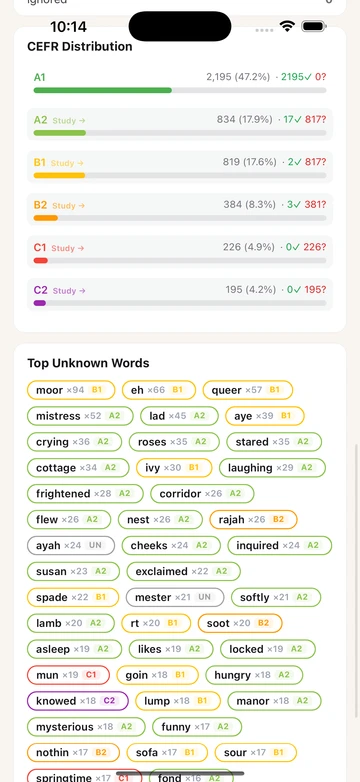
In the TeakReader app, you can go one step further. It compares the book with the words you know and shows your coverage for each chapter. Then it turns the missing words into flashcards.
Sources: Hu, M. & Nation, I.S.P. (2000), Unknown vocabulary density and reading comprehension. Nation, I.S.P. (2006),How large a vocabulary is needed for reading and listening? Laufer, B. (1989), What percentage of text-lexis is essential for comprehension?