trifles
17× in this editionsmall, unimportant things
Original-edition reading analysis
Everyday family life told in clear, warm English. Coverage is high, but the complete book (both parts) is very long, and some words about clothes, manners and home life are old-fashioned. Our recommendation for the complete original is B2.


Updated
Short answer
Yes, for a B2 learner. The language is simpler than most Victorian novels and the vocabulary coverage is high. The real challenge is length, so set a steady pace and treat the two parts as two books.
Vocabulary profile
The bars show the share of running word tokens—not the share of unique dictionary entries. Common words repeat often, so token coverage is the more useful signal for how frequently a learner may meet unfamiliar language while reading.
These are TeakReader frequency-based vocabulary bands, not official CEFR assignments for every word or an official CEFR certification of the book. They are most useful as comparative reading signals.
Beyond the percentages

Useful words to preview
These manually reviewed words recur in the analyzed edition and are more useful to prepare than one-off names. Counts are case-insensitive and include the exact form shown.
small, unimportant things
in a serious, calm way
very formal and correct; easily shocked
a small room at the top of a house, under the roof
shy and easily embarrassed
quietly thinking about something, often sadly
funny in an odd or clever way
happy fun and laughter
sadly wanting something you cannot have
sorry for doing something wrong
A practical reading plan
Transparent methodology
We downloaded the UTF-8 plain-text edition from Project Gutenberg ebook 514, removed the standard Gutenberg header and footer, lowercased English word tokens, and matched them against the same ranked frequency data TeakReader uses for vocabulary analysis. We then combined token coverage with editorial review of syntax, narration, dialect, historical context, and wordplay.
Vocabulary coverage is informative but not a complete readability score. Research on reading comprehension commonly distinguishes knowing most running words from understanding every sentence; syntax and background knowledge still matter. See this Cambridge overview of lexical coverage research for context.
FAQ
We recommend B2 for the original text. Everyday family life told in clear, warm English. Coverage is high, but the complete book (both parts) is very long, and some words about clothes, manners and home life are old-fashioned. This is an editorial estimate based on vocabulary coverage and literary features, not an official CEFR rating.
It ranks 7 of 24 in our list of classic books by reading level (1 = easiest): clear but very long. A reader who knows the B1 word bands knows about 95.71% of the words in the original text, and 97.2% at B2.
Yes, for a B2 learner. The language is simpler than most Victorian novels and the vocabulary coverage is high. The real challenge is length, so set a steady pace and treat the two parts as two books.
Graded readers usually tell only Part One, in a few thousand words. This page analyzes the complete original, both parts, in Project Gutenberg ebook 514.
We analyzed the Project Gutenberg plain-text edition (514) against TeakReader’s English frequency list. The analysis found 178,952 word tokens and 10,728 unique forms after removing Gutenberg’s header and footer. Proper names, dialect spellings, inflections, and tokenization can affect the result.
Yes. The edition analyzed here is available free from Project Gutenberg. TeakReader can search Project Gutenberg books and add them to a vocabulary-focused reading library. Availability can vary by country because copyright terms differ.
Ready to read
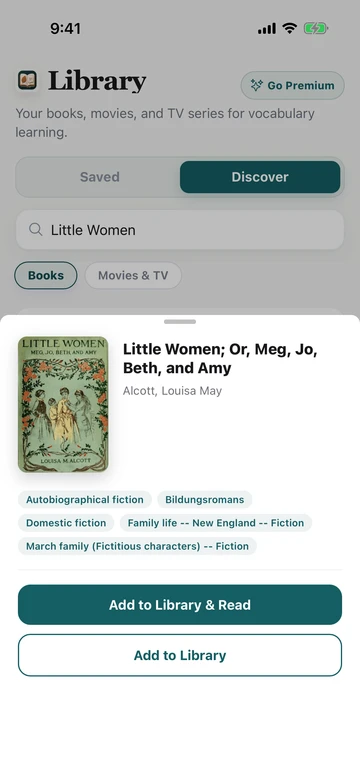
Find public-domain classics, check unknown words, look up definitions, translate difficult sentences, and review vocabulary in TeakReader.