C1 at a glance
C1 reading level in numbers
| Also called | Advanced |
|---|---|
| Known words* | 3,750–4,500 of the most common words |
| Cambridge exam | C1 Advanced (CAE) |
| IELTS | 7.0–8.0 |
| TOEFL | 95–113 (iBT) |
* Milton (2010), measured on the 5,000 most common English words. CEFR itself does not define word counts. IELTS from Cambridge English, TOEFL from ETS.
What you can read at C1
- Nearly all fiction, including nineteenth-century classics, for pleasure.
- Long articles and non-fiction on unfamiliar topics.
- Irony, humour, and an author’s attitude, not just the facts.
- Fast TV comedy and drama without subtitles, with occasional misses.
What is still hard
- Very specialised vocabulary, like the whaling chapters in Moby-Dick.
- Dense literary prose (Joyce, Faulkner) and old poetry.
- Strong regional dialects written out on the page, as in Wuthering Heights.
Classic books for C1 readers
We measured the full original text of 24 classics. The percentage is how many of the book’s words a C1 reader knows. About 98% feels comfortable; at 95% you look something up in every paragraph (why 98% matters).
Good fit at C1
- Treasure Island98.2% known at C1 · Upper B2
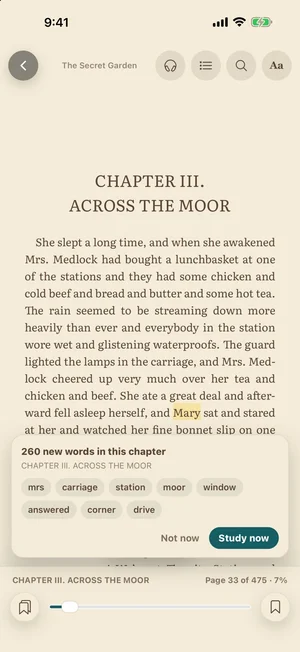
- The Secret Garden97.4% known at C1 · Upper B2
- Tom Sawyer97.7% known at C1 · Upper B2
- Anne of Green Gables96.6% known at C1 · Upper B2
- A Christmas Carol96.7% known at C1 · Upper B2
- The Call of the Wild97.1% known at C1 · Upper B2
- The Great Gatsby97.2% known at C1 · Upper B2 to C1
- Dr Jekyll and Mr Hyde97.9% known at C1 · Upper B2 to C1
- The Picture of Dorian Gray98.4% known at C1 · Advanced B2 to C1
- Pride and Prejudice98.5% known at C1 · Advanced B2 to C1
- Emma98.6% known at C1 · Advanced B2 to C1
- Frankenstein98.7% known at C1 · Advanced B2 to C1
- Jane Eyre98.2% known at C1 · Advanced B2 to C1
- Great Expectations97.3% known at C1 · Advanced B2 to C1
- Around the World in 80 Days96.0% known at C1 · Advanced B2 to C1
- Wuthering Heights97.1% known at C1 · Advanced B2 to C1
A stretch, with a dictionary
- Moby-Dick95.9% known at C1 · Advanced C1
Names and rare word forms count as unknown here, so real comfort is a little higher. Style matters too: Emma has the most known words of all 24 books but is still hard because of its irony.
TV shows for C1 learners
Measured from English subtitles. Speed matters as much as vocabulary when you watch.
- Sherlock98.6% known at C1 · 151 words per minute
- The Big Bang Theory97.5% known at C1 · 154 words per minute
- Brooklyn Nine-Nine97.6% known at C1 · 179 words per minute
- Gilmore Girls98.0% known at C1 · 185 words per minute
C1 words you will meet in books
A few examples from our C1 vocabulary list:
- smug too pleased with yourself
- nimble quick and light in movement or thought
- pedantic too worried about small rules and details
- forthright direct and honest in what you say
- talkative liking to talk a lot
- temperamental with moods that change quickly; or unreliable